
What Every Japanese Buying Property in New Zealand Needs to Know in 2026

Japan and New Zealand have one of the quieter but more structurally significant bilateral relationships in the Asia-Pacific. Japan is consistently New Zealand’s third or fourth-largest source of international tourists. Japanese visitors are Queenstown’s single largest international market by visitor nights in most seasons. Japan–New Zealand trade relationships are embedded in the CPTPP framework. And yet Japanese buying property in New Zealand remains one of the least visible conversations in the APAC buyer market, not because of lack of interest, but because of a specific information gap that this guide is designed to close.
If you are a Japanese citizen or resident considering New Zealand property investment in 2026, whether for yield, capital preservation, lifestyle use, or migration planning, this guide covers everything you need to know to move from research to action.
1. Japanese Buying Property in New Zealand: What the OIA Actually Says
The Overseas Investment Act 2018 is the starting point for every non-resident APAC buyer looking at New Zealand property. Understanding where Japanese buyers sit in the OIA framework is the first question to answer, and the answer is more nuanced than many advisors present.
The general rule: Non-resident overseas persons (including Japanese nationals without NZ residency) generally cannot purchase established residential property in New Zealand without OIO (Overseas Investment Office) consent. This is the restriction that applies to most Japanese buyers approaching the NZ market without existing residency or citizenship status.
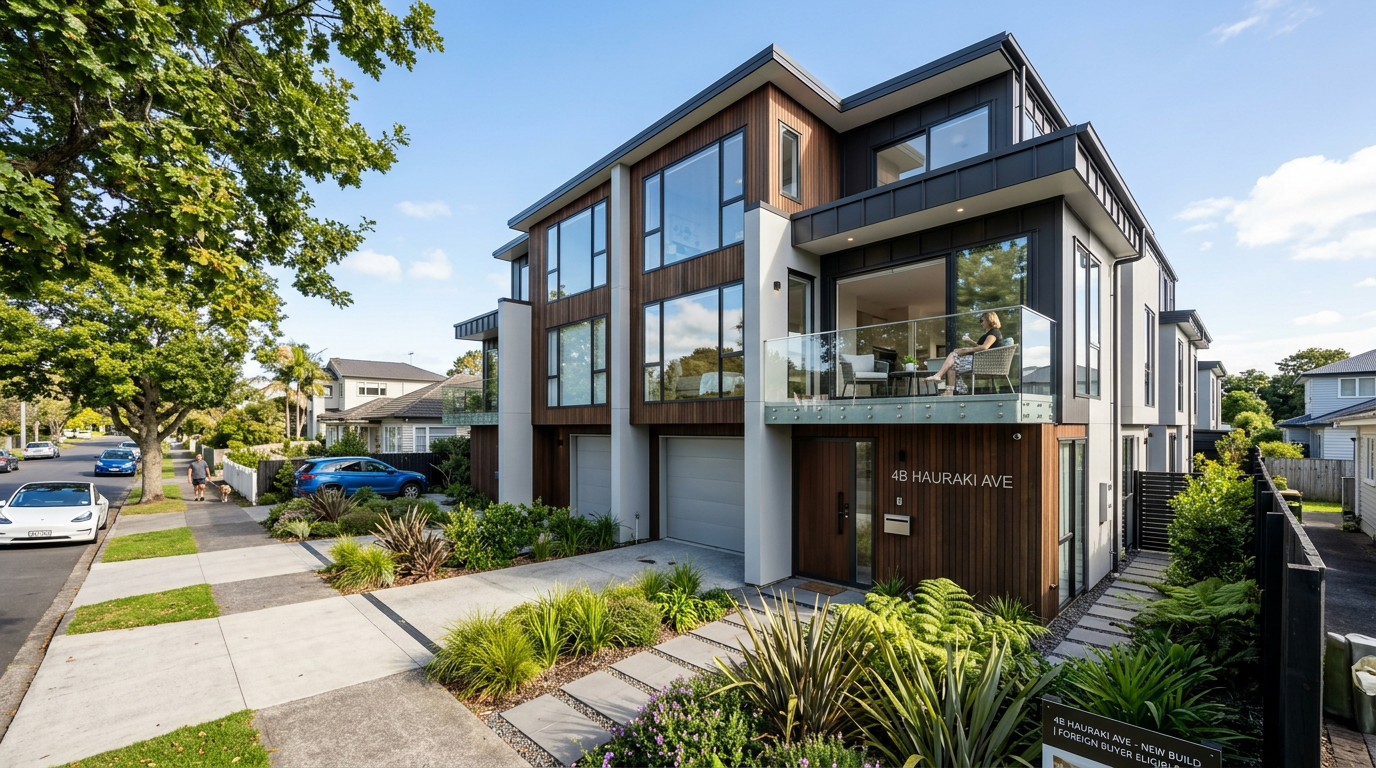
The new build exemption, the key gateway for Japanese buying property in New Zealand: Under the OIA, new build and off-plan residential properties are classified as Foreign Buyer Eligible. Japanese buying property in New Zealand can purchase Foreign Buyer Eligible new build properties without OIO consent, regardless of their visa or residency status. This exemption is not temporary or transitional, it is a permanent structural feature of the NZ overseas investment framework, specifically designed to encourage offshore capital into new residential construction.
What “Foreign Buyer Eligible” means in practice for a Japanese buyer:
- You can purchase the property without applying for OIO consent
- No eligibility assessment, no government approval timeline, no uncertainty about whether your purchase will proceed
- The purchase proceeds on standard New Zealand property law timelines, offer, due diligence, unconditional, settlement
- You own the property freehold (if freehold title) with the same legal rights as any NZ resident owner
The Japan–NZ CPTPP connection: Japan and New Zealand are both signatories to the Comprehensive and Progressive Agreement for Trans-Pacific Partnership (CPTPP). The CPTPP does not create a blanket property purchase exemption for Japanese nationals buying property in New Zealand, but it does establish investment frameworks that facilitate cross-border capital flows between member states. Japanese investors operating through registered corporate structures may have additional pathways available under CPTPP provisions, a qualified NZ property lawyer can advise on the specific application to your situation.
The practical takeaway: For Japanese buying property in New Zealand as individuals, the Foreign Buyer Eligible new build pathway is the clean, certain route. For Japanese corporate investors or family trusts, additional structures may be worth exploring with legal advice.
2. Japanese Buying Property in New Zealand: The Tax Framework You Need to Understand Before Settlement
New Zealand’s tax framework for property investors is structurally different from Japan’s, and understanding the differences before you purchase, not after, is essential.
New Zealand has no stamp duty. Every APAC buyer from markets with significant transaction taxes (Japan’s real estate acquisition tax, registration and license tax, and fixed asset tax can combine to meaningful transaction costs on Japanese domestic property) finds this one of the most immediately compelling features of NZ property ownership. The absence of stamp duty means your acquisition cost is materially lower than an equivalent transaction in Japan.
New Zealand has no annual land tax or wealth tax on property. Japanese property owners pay fixed asset tax (固定資産税) and city planning tax (都市計画税) annually on Japanese real estate holdings. New Zealand has no equivalent annual wealth-based property tax. Your annual holding cost in New Zealand is limited to council rates (local government levy, typically NZD $1,500–$4,000/year depending on property value and location), body corporate fees if applicable, and insurance.
New Zealand’s Bright-Line Test: This is the closest NZ equivalent to a capital gains tax on residential property. If you sell a residential property within the bright-line period, currently 2 years for new builds, 10 years for established properties, any gain is taxable as income. For Japanese buying property in New Zealand with a long hold horizon (which characterises most APAC investment strategies), the bright-line test is not a material constraint. For Japanese buying property in New Zealand considering a shorter-term purchase, the new build 2-year bright-line period is relevant.
New Zealand rental income is taxable in NZ. If you lease your NZ property (short-term or long-term rental), the rental income is subject to New Zealand income tax. As a non-resident, a non-resident withholding tax (NRWT) regime applies to rental income. The Japan–New Zealand Double Tax Agreement (DTA) is in force, this prevents double taxation, meaning tax paid in NZ on NZ-source rental income is credited against your Japanese tax liability. A Japanese tax accountant familiar with the Japan–NZ DTA should be consulted before you receive your first rental payment.
GST on residential property: Residential property transactions are generally exempt from New Zealand GST. Commercial property transactions are not, relevant if you are considering commercial property investment.
3. The Queenstown Opportunity, Why Japan Has a Structural Advantage in NZ’s Most International Market
Japanese buying property in New Zealand arrives with a specific advantage that few other APAC buyer groups share: Japan is Queenstown’s largest and most loyal international visitor market.
The Japan–Queenstown relationship predates mass Chinese tourism to New Zealand by decades. Japanese ski culture discovered Queenstown and Wānaka in the 1980s, and the winter ski season has remained a consistent draw for Japanese visitors ever since. The summer season has grown significantly, driven by New Zealand’s clean environment positioning and Japan’s growing appetite for southern hemisphere summer experiences during Japan’s own brutal summer months.
This visitor relationship has direct implications for Japanese buying property in New Zealand in the Queenstown/Otago market:
Japanese short-term rental demand is embedded. Queenstown’s short-term rental market has a deep Japanese visitor base that is language and experience familiar. A Japanese owner managing or marketing a Queenstown short-term rental property has a natural connection to one of the market’s strongest demand segments.
Seasonal complementarity. Japan’s Golden Week (late April–early May), Obon (August), and New Year periods generate concentrated outbound travel demand that aligns well with Queenstown’s shoulder-season occupancy. A Japanese investor who also uses their Queenstown property for personal stays can structure their ownership around Japanese holiday patterns in a way that other investor nationalities cannot.
The lifestyle migration option. New Zealand’s immigration framework includes pathways (Investor visas, Skilled Migrant visas, and others) that are attractive to high-net-worth Japanese nationals who are evaluating lifestyle diversification. Owning a NZ property, particularly a Foreign Buyer Eligible new build, before committing to a visa application gives Japanese buying property in New Zealand an established base and a material NZ connection that supports an eventual immigration case.
For Japanese buying property in New Zealand evaluating Queenstown property investment specifically, James Yuen at Remarkables Property Group is the APAC specialist on AsetraX for the Otago market. James is bilingual in Cantonese and Mandarin and experienced with APAC cross-border purchases; for Japanese-speaking buyers, he works with interpreters and can structure communication through Line or Zoom to accommodate APAC time zones.
Browse the AsetraX Queenstown listings, every Foreign Buyer Eligible property is clearly tagged.

4. Financing Japanese Buying Property in New Zealand
Financing is where Japanese buying property in New Zealand most commonly encounter unexpected friction, and understanding the NZ lending landscape before you need a mortgage avoids the most common delay points.
New Zealand banks will lend to non-resident Japanese buying property in New Zealand, under specific conditions. The major NZ retail banks (ANZ, BNZ, Westpac, ASB, Kiwibank) have non-resident lending programmes, but the criteria are more restrictive than for NZ residents. Key parameters for Japanese buying property in New Zealand:
- LVR (loan-to-value ratio): Non-resident offshore buyers typically receive a maximum LVR of 60–70%, meaning you need a minimum 30–40% cash deposit. For a NZD $750,000 property, that’s NZD $225,000–$300,000 in equity upfront.
- Income verification: NZ banks require documented, verifiable NZ-dollar equivalent income. Japanese salary income (円-denominated) needs to be converted and assessed under NZ serviceability standards. This can be complex, use a mortgage broker experienced with Japanese applicant files.
- Credit history: Japanese credit histories are not directly portable to NZ. NZ banks assess non-resident applicants differently from domestic applicants. A mortgage broker will navigate this.
The cash purchase option is common among Japanese investors. Given the complexity of non-resident financing and the yen-NZD exchange rate dynamics (the NZD has been at historically attractive levels for Japanese buyers in the current cycle, NZD/JPY has been in the 90–100 range, making NZ property significantly more accessible in yen terms than it was in the 2010s), many Japanese buying property in New Zealand purchase with cash or use Japanese domestic lending (secured against Japanese assets) to fund the NZ purchase.
Using Japanese real estate equity: Japanese buying property in New Zealand with high-net-worth who hold appreciated Tokyo, Osaka, or Kyoto real estate with low loan-to-value ratios can access Japanese bank lending secured against their domestic property portfolio and deploy the proceeds into NZ property. This avoids NZ bank non-resident lending criteria entirely and typically achieves lower interest rates than NZ lending. A Japanese financial adviser familiar with cross-border asset deployment can structure this.
5. The Property Types Japanese Buying Property in New Zealand Most Commonly Purchase
Understanding which property types align with different Japanese buyer profiles helps narrow the search before you engage an agent.
Queenstown investment apartments (short-term rental model):
The most common entry point for Japanese buying property in New Zealand as a pure investment. Off-plan 1–2 bedroom apartments in Queenstown Central, priced from NZD $749,000, offer Foreign Buyer Eligible status, professional management capability, and a direct connection to the Japanese visitor market that underpins Queenstown’s STR economy. The off-plan 2-bedroom alpine apartment in Queenstown Central on AsetraX is the reference listing for this profile.
Auckland new build townhouses (long-term tenancy model):
For Japanese investors seeking yield without short-term rental management complexity, Auckland new build townhouses in growth corridors (Hobsonville, Papakura, Takapuna fringe) deliver 4.5–5.5% gross yield on Foreign Buyer Eligible stock, with professional property management available and minimal owner involvement required. The Hobsonville Point townhouse listed on AsetraX is representative.
Lifestyle homes in Nelson, Queenstown, and the South Island:
For Japanese buying property in New Zealand with lifestyle use in mind, a property they will visit 2–4 times per year while letting professionally in between, the South Island’s lifestyle markets (Nelson, Marlborough, Queenstown’s Kelvin Heights peninsula, Wānaka) offer the combination of genuine lifestyle value and rental income that characterises the “lifestyle investment” model popular with Japanese UHNW buyers in European and North American markets.
Christchurch off-plan apartments:
For Japanese buying property in New Zealand seeking the strongest net yield at the lowest entry price point, Christchurch’s off-plan apartment market offers Foreign Buyer Eligible stock from NZD $485,000 with gross yields of 6.5–7.0% in inner-ring suburbs. The lower capital commitment makes this accessible for Japanese buying property in New Zealand who want to establish a NZ property position before committing to a higher-value purchase.
6. The Practical Process: How Japanese Buying Property in New Zealand Works Step by Step
New Zealand’s property purchase process is efficient by international standards. For Japanese buyers accustomed to Japan’s complex real estate transaction process, with judicial scriveners, mandatory disclosure documents, and a registration system that moves slowly, NZ property purchase will feel faster and simpler, though with different professional requirements.
Step 1: Establish your legal eligibility
Confirm you are purchasing a Foreign Buyer Eligible property (new build or off-plan). Use the LINZ eligibility tool to confirm your specific status. Brief a NZ property lawyer before making any offer.
Step 2: Engage a NZ property lawyer
You need a NZ-qualified solicitor to handle the purchase. They will conduct title due diligence, review the sale and purchase agreement, handle the trust account settlement, and register the title transfer. Expect legal fees of NZD $1,500–$3,500 for a standard residential purchase. Many NZ property law firms have experience with Japanese buyer transactions and can communicate via email in English. A bilingual Japanese/English legal assistant at your chosen firm is a significant practical advantage, ask specifically whether this is available.
Step 3: Source finance or confirm cash position
If financing through NZ banks, engage a mortgage broker early, non-resident applications take longer to process than domestic applications. If using Japanese domestic financing or purchasing with cash, have your funds ready in a NZ-accessible structure before making an offer.
Step 4: Make an offer via your NZ agent
Your AsetraX agent will prepare the sale and purchase agreement and negotiate on your behalf. Standard NZ offer conditions include a due diligence period (typically 10 working days for new builds) and a finance condition if applicable.
Step 5: Due diligence period
Your lawyer conducts title search, LIM (Land Information Memorandum from council), and reviews all developer documentation (for off-plan) or building inspection (for existing properties). The LIM confirms any council-recorded building consents, resource consents, or hazard notices on the property.
Step 6: Go unconditional and pay deposit
Once due diligence is complete and conditions are satisfied, you go unconditional. A 10% deposit (for off-plan) or the agreed deposit is held in the lawyer’s trust account.
Step 7: Settlement
For off-plan purchases, settlement occurs at completion of construction, typically 12–36 months after going unconditional. For established properties, settlement is typically 20–30 working days after going unconditional. Your lawyer handles the balance payment and title registration. You receive the keys (or your property manager does, if the property is immediately going into a rental programme).
Step 8: Register with IRD and set up a rental programme
If you are receiving rental income, you must register for an IRD (Inland Revenue) number in New Zealand. Your property manager or NZ accountant can facilitate this. It is straightforward and takes 1–2 weeks.
7. Finding the Right Agent for Japanese Buying Property in New Zealand
The agent you work with determines the quality of your NZ property investment experience more than any other factor, the suburb selection, the developer assessment, the price negotiation, and the post-settlement property management setup all flow from your agent relationship.
For Japanese buying property in New Zealand, the specific requirements are:
- APAC cross-border experience, not just NZ property knowledge, but genuine experience guiding non-resident buyers through the OIA framework, non-resident finance, and cross-border settlement
- Foreign Buyer Eligible specialisation, knowing which stock qualifies, which developers are reliable, and which precincts are performing
- Communication flexibility, ability to communicate via Line, WhatsApp, Zoom, and email at APAC-friendly hours; willingness to work through an interpreter or bilingual liaison for Japanese-speaking buyers who are not comfortable conducting a complex financial transaction in English
Every agent on the AsetraX platform is listed with their APAC specialisations, language capabilities, and service areas clearly shown. Japanese buyers evaluating Queenstown and Otago should contact James Yuen at Remarkables Property Group directly. For Auckland and Christchurch enquiries, Rajan Mehta and Priya Nair are the platform’s respective specialists.
Japanese Buying Property in New Zealand: The 2026 Opportunity Summary
| Factor | What It Means for Japanese Buyers |
|---|---|
| No stamp duty | Lower acquisition cost than comparable Japanese domestic property |
| No annual land/wealth tax | Lower holding cost than Japan’s fixed asset tax regime |
| Japan–NZ Double Tax Agreement | No double taxation on NZ rental income |
| Foreign Buyer Eligible new builds | No OIO consent required, purchase proceeds without government approval |
| NZD/JPY exchange rate | NZD historically accessible in JPY terms in current cycle |
| Queenstown Japanese visitor base | Structural STR demand from Japan’s most loyal outbound tourism market |
| CPTPP membership | Bilateral investment framework between Japan and NZ |
| Immigration pathways | Property ownership supports eventual NZ visa applications |
Your Next Steps
Japanese buying property in New Zealand in 2026 has a clear, well-defined path. The Foreign Buyer Eligible framework removes the regulatory uncertainty that previously made NZ property inaccessible to non-resident APAC buyers. The tax framework is favourable. The currency is accessible. The market is at a compelling point in the cycle.
Your next steps:
- Browse Foreign Buyer Eligible listings on AsetraX, filter by Foreign Buyer Eligible status and your preferred city
- Read the Queenstown property investment guide if Queenstown is on your shortlist
- Confirm your OIA eligibility using the LINZ eligibility tool
- Brief a NZ property lawyer on your intended purchase structure before making any offer
- Contact James Yuen (Queenstown/Otago) or Priya Nair (Christchurch/South Island) for a no-obligation consultation via Zoom at Japan-friendly hours
The information in this article is for general guidance only and does not constitute legal, financial, or tax advice. Always verify current requirements with a qualified New Zealand lawyer, NZ tax adviser, and Japanese financial adviser familiar with cross-border investment before proceeding with any purchase.
Browse Foreign Buyer Eligible properties on AsetraX, every eligible listing clearly marked.